Aging wells need more than scheduled inspections
The whitepaper shows how monitoring, alerts, and unified data help teams catch issues earlier.

Published: 16 April, 2026 · 11 mins read
Mature oil wells may still rely on visual inspections, paper logs, and schedule-based maintenance. Those lead to underperformance, which teams may mistakenly write off as inevitable. Discover how a proactive, predictive approach to aging oil well maintenance can help prevent failures, reduce downtime, and improve decision-making.
You can’t fight the passage of time or the basic physics. With time, any oil well declines. With time, even the most cutting-edge infrastructure becomes outdated.
Naturally, more and more oil wells go out of commission. (Case in point: the number of oil and gas wells declined from 1,031,161 in 2014 to 918,481 in 2024 in the U.S. alone.)

Source: EIA: U.S. Oil and Natural Gas Wells by Production Rate
With an estimated 70% of the oil produced today coming from mature fields, aging oil well maintenance is hardly a niche problem. Aging wells have consumed 90% of upstream investment since 2019. That investment could have been allocated to finding new sources of supply; instead, it went to offset production decline.
While by no means a silver bullet, shifting to oil well predictive maintenance can help you extend your assets’ lifespan. Keeping mature wells in operation longer, in turn, creates a good buffer to help you navigate demand spikes while you’re scouting new prospective fields.
Built and put into service decades ago, the overall energy infrastructure is aging across countries. In the U.S., for example, it earned a D+ in the ASCE’s 2025 report. The report mentions aging oil and gas pipelines that are still in use even though their intended design lifespan has expired.
A quarter of oil production comes from the fields aged 50+ years, and their share has doubled since 2000. And although their yields are declining, the fields started before 2000 are still in operation. In turn, yields from pre-1970 fields remain relatively stable at around 25 mb/d.

Source: IEA, The Implications of Oil and Gas Field Decline Rates
Of course, oil well aging doesn’t follow the same trajectory everywhere. Horizontal wells, for example, show higher yields at the very start of production than vertical ones, but their decline follows a much steeper curve. (In the United States, these wells account for 94% of oil production.)

Source: EIA, Rapid declines from horizontal wells require more drilling to sustain production
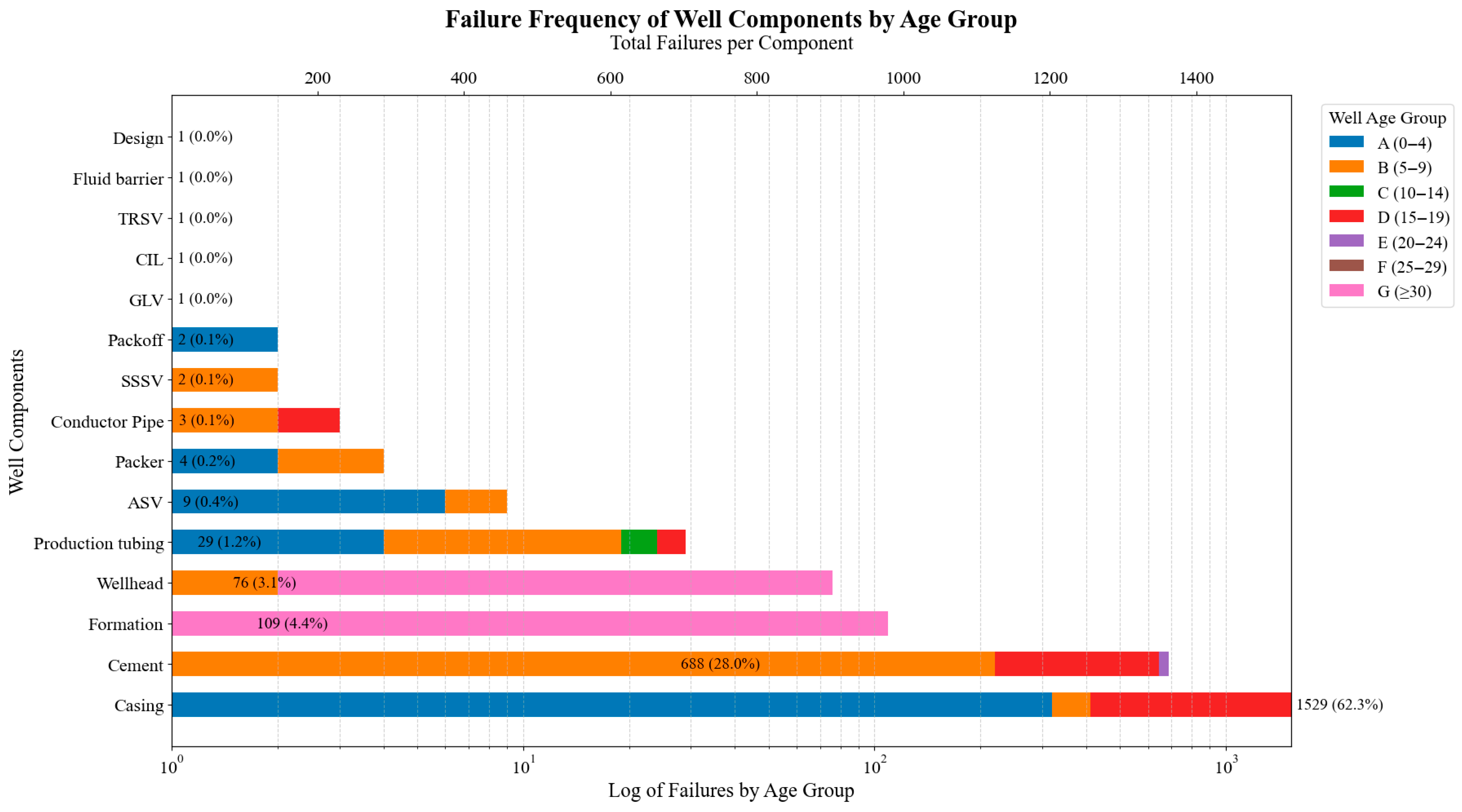
The oil well type isn’t the only factor that impacts well lifecycle management, either. Well integrity failures often stem from casing (62.3%) and cement failures (28%), far ahead of formation or wellhead failures (4.4% and 3.1%, respectively). That said, casing and cement failures are prevalent in wells under 20 years old; formation failures take the lead among wells more than 30 years old:

Source: EIA, Rapid declines from horizontal wells require more drilling to sustain production
As SLP CEO Olivier Le Peuch aptly put it, “Even as drilling activity slows down, the existing wells still need just as much servicing and maintenance.”
Yet, you can’t expect to perform the same kind of maintenance as wells grow older. Aging oil well maintenance poses a completely different challenge in that regard, due to:

Source: Maintenance Management of Aging Oil and Gas Facilities
If left unaddressed, these technical and operational issues can cause unplanned downtime. In the oil industry, the cost of that downtime is tied to oil prices. Considering that the recent spikes in oil prices are comparable with the market volatility of 2022, Siemens’ 2022 estimate that an hour of downtime costs oil companies almost $500,000 probably rings true today.
The whitepaper shows how monitoring, alerts, and unified data help teams catch issues earlier.
Reactive maintenance is simple on the surface: wait for something to break, and only then fix it. But that’s a recipe for unplanned downtime, additional safety risks, and expensive repairs.
There is a better way: proactive maintenance. This approach focuses on preventing failures with interventions at the early signs of trouble. It can reduce maintenance costs by 40% and downtime by as much as 140 hours per company.
Here’s how to maintain aging oil wells by moving from reactive maintenance to condition-based, software-enabled maintenance.
In reactive maintenance, engineers rely on regular inspection rounds to discover any signs of asset degradation. If vibration becomes excessive, the team will learn about it only when the next inspection round rolls around. In the meantime, the equipment may degrade faster or fail altogether.
In proactive maintenance, well integrity monitoring software collects real-time data from IoT sensors installed throughout the site, including within the equipment itself. Those sensors continuously capture information about the pressure, temperature, vibration, and more. A centralized monitoring layer brings together and visualizes that data in real time, sending alerts for deviations from normal ranges.
The moment the pressure drops below a certain threshold, the team receives an alert. Engineers can investigate the problem and fix its causes early, before it disrupts production. This kind of continuous surveillance and real-time analysis increased production by 4% and protected 10% more from going offline for BP, for example.
In reactive maintenance, inspection records may still live on paper. The same goes for failure reports, intervention outcomes, and operational conditions (e.g., borehole measurements). Paper logs take longer to access and search, require manual analysis, and can easily be destroyed by water, fire, or time itself as the ink fades.
In proactive mature well production optimization, all data is captured automatically and loaded into a unified data platform, without paper handling or manual data entry. The platform cleans and prepares data for future analytics, with its results displayed in user-friendly dashboards.
Teams can work directly with analytics insights instead of raw data, and all the information they need is at their fingertips. That means quicker mature well production optimization decisions based on correlations between failure history, inspection records, and operational parameters that could otherwise go unnoticed.
In reactive maintenance, the team follows a fixed schedule for component replacement and servicing. However, the same piece of equipment degrades at different rates, depending on operating conditions. Creating custom schedules for every site isn’t a solution: it would be too time-consuming.
In proactive maintenance, well maintenance software for oil and gas uses captured data points to pinpoint when a component’s performance starts deviating from the baseline. The software sends out alerts to maintenance teams, together with asset context. That’s how teams know exactly when a specific asset needs maintenance and can prioritize their work thanks to alerts’ criticality scores, grouping, and context.
In reactive maintenance, coordinating data flows becomes a job in and of itself. Sharing data with asset managers, compliance managers, and field operators requires manually locating the information, duplicating or digitizing it, and sending it over. It is time-consuming, to say the least, and it slows down decision-making, too.
In proactive maintenance, oil well maintenance software puts data insights at everyone’s fingertips. Anyone who needs access to a specific indicator, log, or report can simply open the application and pull it up. No back-and-forth necessary.
As a result, everyone is on the same page regarding inspection findings, maintenance history, and sensor data. Teams can focus on their primary tasks instead of requesting and sending data to other stakeholders.
Gain full visibility into your assets’ performance and minimize disruptions with Exoft’s well maintenance software for oil and gas.
Want to know what reactive vs predictive maintenance for oil and gas wells means in real-world conditions? Look no further than Exoft’s experience with oil well predictive maintenance software.
In 2020, a tech startup from the Middle East turned to Exoft for help with developing its custom oil rig monitoring platform. Already in the early development stage, the startup quickly realized that the initial codebase’s scalability and maintainability left much to be desired.
As a primary development partner, Exoft took on backend development tasks, optimizing the existing codebase and building multiple real-time monitoring and data analysis features. Those features empower asset managers to move away from visual inspections to continuous monitoring and:
The unified oil well data platform Exoft delivered for a European digital oilfield vendor, in turn, centralizes operational data and turns it into insights. The diversity and volumes of data were the main challenges for both its prospective users and our client. It was up to Exoft’s team to make the system work smoothly and visualize data in dashboards.
Exoft rose to the challenge and delivered a solution with an intuitive executive, production engineering, and monitoring and control dashboards. As a result, the data platform helps users leave paper logs and manual analysis in the past by:
Finally, Exoft’s work on the ESP failure system helped its vendor overcome performance issues and align the system with user needs. Exoft modernized the application, optimized its performance, and added new features in phases that last four to five months.
Now, the system offers twice as many features and integrations as before and can easily accommodate new oil well operators and third-party equipment suppliers. Users, in turn, can leave paper logs behind and:
You may accept equipment degradation, with all the production decline, failures, and downtimes, as part of doing business. But it doesn’t have to be. Real-time monitoring, unified data views, condition-based maintenance alerts, and enhanced data visibility can prevent failures before they occur and boost well performance.
Exoft has been helping oil and gas companies switch to proactive, data-driven maintenance for over a decade. Discover our expertise in software solutions for asset performance monitoring, artificial lift management, and production optimization for oil and gas companies.
Already have a real-time monitoring solution in mind? Data volumes, diversity, and visualization needs can stand in the way. Get in touch with Exoft’s experts to discuss how we can help you navigate these and other challenges.
Unlike newer wells, their aging counterparts have to grapple with compounding equipment degradation, lack of data, and disconnected systems. Degradation acceptance can also pose a challenge.
Electrical faults cause ESP failures in over half of all cases (61%). Motor failures and gas effects can also cause pumps to fail, albeit not as frequently.
Well maintenance software collects and analyzes real-time and historical asset data to pinpoint when indicators deviate from the baseline and alert the maintenance team. The team can then intervene early on and fix the issue before the equipment fails.
Older wells that frequently suffer from disruptions and equipment failures should be at the top of your list. We also advise you to take well performance into account. If it took an unexpected dive, the equipment may not be operating at 100%.
Bring together (and digitize if necessary) well logs, asset information, inspection records, and maintenance and servicing history. Make sure assets are also equipped with IoT sensors that can supply real-time operational data to the system.
To quantify the savings from implementing the software, consider the prevented downtime, extended asset life, and improved production efficiency and yield. Then, estimate the costs of implementing and maintaining the software itself.