
Oil rig reliability is no longer about keeping systems running. It’s about knowing asset conditions early, preventing failures, and maintaining safe, stable performance over time. This post explores how asset monitoring software makes this possible by connecting real-time data, inspections, and workflows into one reliable system.
In oil and gas, reliability means far more than “the rig is running.” Asset uptime alone doesn’t define whether an operation is truly reliable. That’s because equipment can be running and still be unsafe, unstable, or already on the verge of failure.
Actual reliability means that:
- Your equipment works within safe limits
- Its performance is stable over time
- Your teams detect issues, defects, and degradation at the earliest possible stages.
When you master this definition of reliability, you stop waiting for failure. Oil rig monitoring software helps you move from fixing the broken to maintaining the standard. It gives your operators and asset integrity teams the time they need to act before performance gaps, system breakdowns, and safety violations impact your processes. In this post, we’ll discuss how exactly this happens.
Why Oil Rig Reliability Is Hard to Maintain and Problems Go Undetected
If maintaining a rig were easy, we wouldn’t see the numbers we’re seeing today. Despite the industry’s massive safety and operational improvements, the data reveals a harsh reality.
In 2025, the International Association of Drilling Contractors reported 833 recordable safety cases in its rotary rig safety statistics. According to the Health and Safety Executive’s Offshore Statistics and Regulatory Activity Report 2024, offshore inspections showed that 30% of HSE topic assessments were rated poor or very poor.
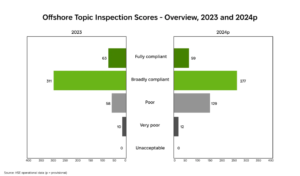
Source: Offshore Statistics and Regulatory Activity Report 2024 by HSE
These aren’t reliability metrics in and of themselves, but they hint at the reality of rig operations: complex assets, imperfect controls, and maintenance/work-control gaps. And while not every problem ends in injury (that’s real progress), plenty still turn into production losses, equipment damage, leaks, and unplanned downtime. The key point is that many of these failures don’t appear overnight — they build up quietly.
So why do problems go undetected? It’s because of:
- Unsystematic visual inspections. We still rely on visual inspections that end up trapped in paper reports, disconnected spreadsheets, or unlogged photos. When visual evidence isn’t systematically compared with operational data, you lose the big picture.
- Raw sensor data without context. Pressure, temperature, vibration, and flow readings are out there. But raw numbers alone don’t describe asset health. Without interpretation, teams see values, not meaning.
- Invisible equipment wear. Gradual degradation is incredibly subtle. Without historical trend tracking, it’s nearly impossible for a human operator to notice a minor performance drop. But over months, the equipment reaches a breaking point.
- Late alerts. Most legacy oil rig monitoring systems are reactive. Alerts often trigger too late, when thresholds are already exceeded.
- Siloed vision. Operations, maintenance, safety, and integrity teams often work with different tools, dashboards, and data sources. If these systems aren’t unified into a single view, decision-making gets fragmented.
- Reactive maintenance. Many teams still depend on reactive or schedule-based maintenance. Instead of acting on real-time asset condition and predictive indicators, they follow legacy service intervals and manual reports.
How Asset Monitoring Software Improves Oil Rig Reliability
Oil and gas asset monitoring software tackles performance, safety, and asset-related decisions simultaneously. That’s precisely what turns reliability from an ephemeral goal into reality.
- Early issue detection. Oil rig management software combines inspection findings with real-time sensor data in a single monitoring layer. This helps detect degradation long in advance. Continuous condition monitoring also allows you to track trends over time and identify early signs of wear, corrosion, or performance drift. And with an alert system, you get another layer of protection.
- Standardization. Reliability often suffers because inspectors use different reporting methods. Software fixes this by enforcing consistent inspection quality, ensuring reliable data capture, and standardizing digital forms aligned with your benchmarks. This makes results comparable across distinct times, locations, and inspection teams.
- Proactive maintenance. A 360-degree view of an asset’s history and current health gives you total control over your operational timeline. This allows you to order and replace spare parts on time, extend a rig’s lifespan well beyond its original 20-to-30-year design, and transition from calendar-based (which isn’t always effective) to condition-based maintenance.
- Safety and risk management. Clear visibility into an asset’s condition helps teams address safety-critical issues faster. It lets you identify high-risk equipment and detect early signs of hazardous exposure. This insight enables smarter risk responses: if a specific zone is marked as high-risk, you can postpone a crew’s deployment there or send in robotic inspection hardware.
- Higher operational efficiency. Finally, there’s the sheer boost in operational efficiency. Manual reporting is a notorious time-sink prone to human error. With oil rig reliability software, the system automatically handles cumbersome data entry and report generation
What Capabilities Does Oil Rig Monitoring Software Have?
Oil rig management platforms connect data, inspections, workflows, safety, and decision-making in one place. Here’s what that looks like in practice:
Data Aggregation & Integration
At the core of any monitoring platform is a central repository for asset data. It combines:
- IoT sensor data, such as pressure, temperature, vibration, flow, load, and other operational parameters
- Inspection inputs, such as visual inspections, drone-based inspections, robotic inspections, and integrity findings such as corrosion, CUI, leaks, holes, inclusions, and material defects
When developing a real-time oil rig monitoring solution, Exoft went even further by embedding custom equations and calculation models that helped make sense of all this raw data. Instead of just seeing numbers, our client’s team could interpret what those values mean for asset health. Thus, they were able to make informed assumptions based on combined variables.
Within the same project, we implemented standardized data structures to ensure consistency across assets and systems. Our team built a scalable architecture that allows for easily adding new assets and sensors. Moreover, configurable workflows enable processes to evolve without requiring system rewrites.
This turned fragmented data streams into a true all-around view.
Digital Inspection & Reporting Flows
Digital inspection workflows replace paper processes, scattered files, and manual reporting with structured, traceable, and automated inspection management. This is an absolute must-have as reliability directly depends on consistency and speed.
At Exoft, we implemented:
- Standardized digital inspection forms and workflows, adaptable to different asset types and inspection standards
- Built-in validation rules to prevent incomplete or incorrect data entry
- Photo and video evidence capture directly within inspections
- Audit trails showing who inspected what, when, and how, based on access permissions
- Automated report generation for condition summaries, trends, and risks
- Automated escalation and approval workflows
This approach was also applied when Exoft was developing an oil and gas data management platform. In particular, we built a solution for large-scale data collection and analysis of well performance. The platform combined advanced analytics with intuitive data management, allowing specialists to process massive data volumes and handle inspections with ease.
Customizable Visualization
Visualization turns complex datasets into clear representations. Oil rig performance monitoring software uses interactive visual layers to make asset health easy to understand at a glance.
At Exoft, we created:
- Real-time dashboards for asset condition, inspection status, and parameter changes
- Visual indicators for risk, urgency, and degradation trends
- Digital representations of rigs and components, with their exact locations mapped
In our oil and gas pipeline management system project, we placed strong emphasis on visualization. The solution processes robotic in-line inspection data using custom formulas, calculations, and algorithms. We translated those outputs into clear visuals: bar and area charts, line graphs, scatter plots, radar charts, and more.
Safety & Compliance Tracking
Oil and gas monitoring software also serves as a safety and compliance system, not just an operational tool. Key capabilities include:
- Traceable inspection histories
- Secure evidence storage
- Compliance-ready reports, forms, and audit logs
One of our projects included modernizing a web portal for ESP failure tracking and DIFA procedures. The system we delivered supported dismantle, inspection, and failure analysis workflows, making DIFA documentation and reporting more precise.
Event Detection Through Alerts
Manual reviews aren’t proactive enough. Smart alerting mechanisms automatically detect abnormal conditions (temperature surges, excessive vibration, pressure anomalies, you name it) and trigger real-time notifications.
These alerts are often color-coded by severity. This helps teams instantly understand urgency and risk level.
Oil & Gas Team Collaboration
Reliability is a team effort, and oil rig maintenance software supports that. In particular, teams can:
- Annotate findings
- Discuss issues directly in the system
- Approve or return inspections and reports
- Track decisions and changes transparently.
Because all operational knowledge is stored in the platform, companies avoid overdependence on individual team members. Knowledge becomes institutional, not personal.
When to Build Custom Asset Monitoring Software vs. Buy a Ready-Made Solution
When it comes to implementing oil and gas software, you generally have two options: build or buy. Here’s when to choose what:
| Build | Buy |
|---|---|
| Assets differ significantly from rig to rig and require custom logic, models, and configurations. | Assets are relatively standardized and follow similar operating patterns. |
| You manage a large, diverse asset portfolio and plan to scale beyond rigs (pipelines, ESPs, terminals, etc.). | You have a small number of assets with limited monitoring needs. |
| You rely on proprietary calculations, thresholds, workflows, and condition models that standard tools can’t support. | You require basic alerts and dashboards for asset monitoring. |
| You require full control over your data, infrastructure, and deployment model (including on-prem environments). | You consider cloud deployment and vendor-managed infrastructure suitable. |
| You need to cross-integrate the solution with your other business systems (ERPs, maintenance platforms, inspection systems, and so on). | Your integration needs are minimal or non-critical. |
Need an offshore asset monitoring solution that fully fits your assets, data, and reliability goals? We’ve got you covered.
Conclusion
At the end of the day, oil rig reliability isn’t built on uptime alone. It’s built on early detection, visibility, consistency, and control. It implies that understanding real-time asset conditions is superior to vague assumptions and delayed reactions.
In this case, asset monitoring software is the foundation for safer, more stable, and more predictable oil and gas operations. Need to implement it? Count on Exoft. Here’s what we bring to the table:
- A broad portfolio of oil and gas software development projects, including pipeline monitoring systems, ESP monitoring platforms, and full-scale digital oilfield solutions
- A deep understanding of real industry pressures. Downtime is a direct financial threat, asset problems develop gradually, compliance is constant, and risk avoidance matters more than buzzwords. AI, digital twins, and advanced analytics are valuable, but only when they’re built on a stable, reliable monitoring foundation
- Experience working with US- and Saudi Arabia-based companies, including organizations later acquired by some of the largest oil and gas operators in the world
- Strong technical depth across oil and gas software development, data engineering, visualization, legacy system modernization, and complex system integrations
If reliability is not just a goal, but a business necessity, we are willing to help you develop the monitoring foundation that supports it.