
As small and mid-sized companies scale, unbalanced and fragmented IT delivery often becomes a growth blocker. This article explores how a wisely chosen managed IT services provider (MSP) removes that burden, while the wrong one could make it worse. It outlines how businesses move from resource-based thinking to outcome-centered partnerships, and what to look for to gain accountability, stability, and business impact.
Many consider managed IT service providers (MSPs) a 100% predictable delivery option. And compared with the growing headaches of outstaffing, it seems more than reasonable. However, without hiring the right external team to reduce your management overhead, you may encounter the same challenges you were struggling to avoid.
How come? In most cases, the root cause is not the model but the poorly chosen service provider. Accountability, maturity, and an outcome-focused approach are some of the core pillars of success here. But of course, that’s just the tip of the iceberg. So, how to choose a managed IT service provider among numerous options available?
Relying on Exoft’s rich expertise in managed IT services, this article will puzzle it out. Ready to learn more? Let’s dive in!
What is a Managed Service Provider for IT?
First, let’s briefly define MSP and determine what differentiates it from other IT cooperation models.
Unlike common models in which vendors support your system or provide professionals for your internal team, a Managed IT Services Provider (MSP) is a long-term, results-oriented partnership. Simply put, you delegate full or partial responsibility for defined technology functions, systems, or delivery areas to a third-party service provider. Therefore, the hired team is accountable for outcomes across the entire project, not just specific work areas.
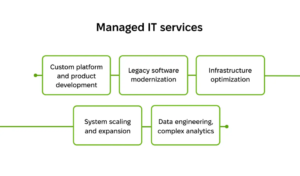
Managed IT services go far beyond simple maintenance and infrastructure tasks. This model covers any IT project or product delivery, including the following:
- Custom platform and product development
- Legacy software modernization
- Infrastructure optimization
- System scaling and expansion
- Data engineering, complex analytics, and more
What Is an MSP Actually Responsible for?
While the scope of the potential solutions an MSP can deliver sounds impressive, this model doesn’t necessarily mean that you’re dealing with a bigger external team. A proficient service provider provides a systematic delivery instead of completing a pile of technical tasks for you.
Here’s what a mature MSP is normally accountable for:
- Outcomes. MSPs take responsibility for project results, not just certain tasks.
- Decision making. Managed providers may develop a project direction if it aligns with your business objectives.
- Quality, stability, and long-term maintainability. You can rely on an MSP over the long term and treat it as an extension of your business, not just a handy tool.
- Incidents, performance issues, and reliability improvements. MSPs are responsible for resolving technical issues and implementing improvements to support your business growth.
- Success-driven approach. MSPs rely on predefined KPIs and SLAs instead of questionable effort-based metrics.
When Managed IT Services Are the Right Fit
Managed IT services are most effective in environments where technology is not a one-time initiative, but a continuous, evolving part of the business. This model works best when you need a partner that can own delivery over time, not just execute isolated tasks.
In contrast, outsourcing and outstaffing models offer short-term solutions for project-based work. If you’re looking for certain expertise or need to cover a talent gap while managing most tech aspects internally, such models might be a better fit.
Here’s a brief comparison table illustrating the difference between MSP and outstaffing partnership models:
| Criteria | Outsourcing / Outstaffing | MSP |
|---|---|---|
| Engagement | Project-based or short-term | Long-lasting tech partnership |
| Focus | Quick task execution | Outcome-based IT service delivery |
| Scope | Predefined and fixed | Evolving over time |
| Delivery and decision ownership | Client | MSP |
| Accountability | Based on roles, tasks, or timeline | Based on certain KPIs and SLAs |
| Micromanagement risk | High | Low |
| Flexibility | Limited | High |
| Common use case | One-off projects, talent augmentation | Long-term projects with evolving systems and products |
Both models have pros and cons and remain viable for different use cases. So, the key here is not choosing the best approach—it’s about choosing the right one for your business.
What to Evaluate When Choosing a Managed IT Services Provider?
Now, let’s move on to the most intriguing part – how to select a managed IT service provider that will be a 100% hit for your business reality. Here are the most crucial aspects to consider, along with the right questions to ask your potential vendor before hiring.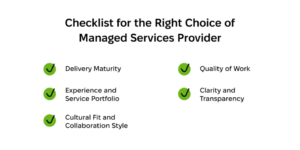
1. Experience and Service Portfolio
The first sign of a reliable MSP is its experience in solving similar problems for other clients. If an MSP has a proven track record of real-world, long-term engagements, it’s more likely to manage your project efficiently.
Check whether a provider can operate within complex, evolving systems, such as legacy software, architectural growth, shifting requirements, and more. MSPs with only short-term projects or delivery sprints within existing systems are less likely to manage the ownership and accountability challenges ahead.
What to ask for?
To evaluate this point, ask your potential managed service provider to share case studies, examples of long-lasting cooperation (preferably with businesses somewhat similar to yours), and repeat engagements. This information will indicate whether a particular MSP can grow with your evolving needs.
2. Delivery Maturity
Look for a managed IT service that guarantees repeatable and transparent delivery. Otherwise, you risk encountering the same issues many outstaffing clients face: last-minute updates, unexpected bottlenecks, and, ultimately, micromanagement.
Want to stay focused on your business? Then ensure the hired MSP provides clear planning, execution, adaptation, and improvement processes. Every project is prone to challenges, from incidents and missing documentation to accumulated tech debt. But mature MSPs rely on a system that works and take on full responsibility for it.
What to ask for?
Make sure to ask the following questions to make sure the hired MSP is mature enough:
- A sample project or delivery plan for managed engagements
- A delivery framework (such as Agile or ITIL)
- An onboarding and transition approach
- An explanation of change management and incident response processes
- Any relevant certifications or process standards followed
Thanks to strong delivery maturity, an MSP remains predictable even if the environment is not. This way, you will be sure that the responsibility for the project’s outcomes won’t bounce back to you.
3. Quality of Work
Another critical aspect to consider is the high-quality delivery of managed IT services. Any MSP will promise to stay accountable for your projects. But how do you check whether the chosen provider can actually meet your expectations?
For that, ensure to evaluate if your future MSP adheres to the following:
- Coding standards and best practices
- Effective testing and QA before deployment
- Consistent and transparent system of documentation (especially when handling systems they’ve taken over)
What to ask for?
Ask your MSP candidate to show sample code repositories or snippets (if allowed) and examples of system or project documentation. Also, request a description of the team’s QA and testing practices (ideally, developed for a similar project in a past engagement).
4. Clarity and Transparency
Clear communication and commitment to results are among the green flags signalling that an MSP is trustworthy. In turn, vague reports and a lack of updates are not an option if you aim for a fruitful, long-lasting partnership.
So, how do you avoid a fuzzy communication trap? Look for an MSP that is ready to commit to specific KPIs and SLAs, proactively flags risks, and clearly describes progress at every step. Finally, the provider should be prepared to make decisions (or ask for your input if necessary).
What to ask for?
To validate an MSP’s transparency, look into their KPI and SLA frameworks from previous engagements. Also, ask about their review and reporting formats, their escalation practices for risks or blockers, and their preferred communication model.
💡 Pro tip: Assess an MSP’s certifications as an additional indicator of vendor reliability. While they alone don’t guarantee high quality, they often indicate process maturity and adherence to industry standards. Delivery, security, or service management certifications may serve as supporting evidence.
5. Cultural Fit and Collaboration Style
Even the most technically savvy and mature MSP may not be an ideal partner for your business due to cultural or working style differences. Remember that a managed IT provider will likely become your ally for a long journey. That includes not only tech aspects but also constant collaboration, knowledge sharing, decision-making, and day-to-day communication.
This is how to select a managed IT service provider you’ll be comfortable working with:
- Conduct early discovery sessions with the delivery team members
- Run workshops with your future partners to simulate the upcoming collaboration
- Start with a trial engagement before jumping into a long-term partnership
Looking for a reliable IT service partner for strong collaboration?
What High-Level Strategic Input Is Required from You, as a Client?
As you can see, managed IT services reduce operational overhead. However, they don’t remove your strategic role in the project. An MSP delivers the desired outcomes if you provide the business direction for their technical decisions.
Let’s review the most significant inputs your team will have after hiring an MSP:
- Clear expectations (the “why”). Define what problems you want the MSP to solve, whether it’s faster delivery, higher quality, modernization, scalability, or operational stability. With a business context, the provider picks the most suitable technical approach.
- Success definition. Communicate your vision of success through KPIs, SLAs, and business outcomes.
- Knowledge sharing. Provide your MSP with documentation, system context, lessons learned, and any other crucial internal knowledge.
- Access and approvals. Grant timely access to systems, environments, and stakeholders. Thus, dependencies won’t block the team’s work.
- Feedback and communication. Remain available for reviews and feedback loops. Thus, the MSP will adapt as your needs evolve.
- Change management. Communicate any priority shifts early on. Managed services are adaptable—but only if informed on time.
Long story short, the ownership of managed services is all about delivery, while you remain responsible for setting the right direction.
What Happens After You Sign a Managed IT Services Contract?
Curious what happens after you’ve hired an MSP? Well, that’s the beginning of the actual journey, which includes working on your system and the delivery model set to scale up with your business.
Here’s what a common onboarding and transition phase normally includes, based on our experience:
- Transferring knowledge and setting up access to systems, tools, and stakeholders
- Reviewing the existing code, documentation, and architecture to understand the current state
- Establishing or strengthening delivery workflows and communication routines
- Identifying structural improvements to reduce risk and inefficiencies
- Addressing urgent issues like performance, quality, or operational bottlenecks
- Refining the scope and backlog, planning every phase, and delivering results
- Reviewing progress against the agreed KPIs and using your feedback to adjust priorities and improve outcomes
Want to learn more about our time-tested process? Discover managed IT service project examples from our portfolio – a web portal for analyzing incidents on ESP and assistive listening systems for improved accessibility.
Do You Lose Control in Managed IT Services Engagement?
A managed service is not a “black box,” as you don’t delegate control over your business to a third party. With a mature and transparent provider, it’s actually the opposite. The hired team delivers the desired outcomes, while you gain full visibility and strategic control.
Let’s look at the most crucial aspects of your cooperation with an MSP in this regard:
- You still own the source code, documentation, and all deliverables.
- Knowledge sharing and documentation maintenance are constant, not rushed at the very last minute.
- A good MSP provides access to information through real-time dashboards and regular reports.
- If you want your MSP to transfer knowledge, access, and processes upon engagement end, discuss it before signing the contract.
- You always have the “right to peek” while the team’s working on your project.
Conclusion
Choosing a proper managed IT service provider company takes time and effort. However, if you’re looking to reduce friction and gain a powerful IT sidekick for your business growth, it’s 100% worth it. With a trustworthy MSP, you gain clear ownership of delivery outcomes and product quality.
Predictable costs, reduced operational risks, improved system reliability, and a focus on your core business priorities are among the most compelling reasons to adopt this model. But again, it’s all possible only with a transparent and mature service provider.
Looking for one? Consider Exoft! With over a decade of experience in providing managed IT services, we are ready to become your trusted partner. Whether you run a non-tech business and want to build an IT system from scratch, or your company requires rebuilding an outdated system, we’re here for you.
Reach out to us to explore whether managed services are right for your business!