Ready to improve your supply chain operations?
Talk to Exoft about a custom software solution built around your workflows.

Updated: 30 July, 2024 · 10 mins read
Supply chain improvement combines process optimization, KPI tracking, automation, and better visibility. Technologies such as ERP, WMS, TMS, AI, and analytics support faster, more resilient operations. Exoft helps businesses implement these improvements through integrations and custom supply chain software.
A good supply chain improvement strategy helps a business balance cost, speed, service quality, resilience, and working capital throughout the whole network.
Balancing these factors is more important now because supply chains deal with ongoing geopolitical changes, shifting trade rules, demand swings, supplier risks, and the need for better traceability. In McKinsey’s 2025 survey of 100 companies, 82% said new tariffs affected their supply chains, with 20% to 40% of their activities impacted.
Many organizations still can’t see much beyond their direct suppliers. While 95% of companies in McKinsey’s survey could track risks with their main suppliers, only 42% had similar insight into their second-tier suppliers or further.
This guide will show you how to:
Effective supply chain improvement usually starts with five steps:
The best mix of improvements depends on the company. For example, manufacturers might focus on supplier risks and material availability. Retailers may care more about demand forecasting and inventory allocation. Logistics providers often need better carrier integration, shipment tracking, and route planning. Healthcare supply chains have another set of priorities, including product availability, expiration management, cold-chain control, and reliable delivery of medical supplies. Technology can help with all these goals, but it’s not a replacement for clear processes, good data, and clear responsibilities.
Supply chain leaders increasingly operate in an environment where volatility is continuous. For instance, in McKinsey’s 2025 research, tariffs affected an average of approximately 30% of global supply chain activities among surveyed organizations. The impact varied significantly by sector: consumer goods companies reported that tariffs affected 43% of supply chain activities, compared with 23% among chemicals companies.
The financial consequences extended beyond the tariffs themselves. Among respondents:
As a result, many organizations expect to handle much of the extra cost themselves instead of passing it all on to customers through higher prices. Companies are responding through familiar resilience measures. Among businesses affected by tariffs are increasing inventory as a short-term buffer, pursuing dual-sourcing strategies, and developing supplier nearshoring or onshoring plans.
These numbers show that supply chain improvement isn’t just about cutting costs. Companies need systems and processes that let them compare options, see how things are connected, and respond quickly when things change.
However, fixing one part of the supply chain by itself can cause issues in other areas. For example, keeping less inventory can lower costs but might lead to stockouts. Adding backup suppliers can make your supply chain stronger but also more complex. Faster delivery can make customers more loyal but may cost more in transportation.
Talk to Exoft about a custom software solution built around your workflows.

Disruption and uncertainty have become prevalent cons in the industry. McKinsey found that only around one-quarter of surveyed organizations had formal processes for discussing supply chain issues at board level. Each of these issues requires innovative solutions and strategic foresight to overcome.
Supply chain leaders face a relentless cost surge, spanning raw materials, labor, transportation, and other operational expenses. These escalating costs directly impact profitability and operational viability, necessitating proactive strategies to mitigate their effects.
Geopolitical tensions challenge supply chain stability. Trade disputes, regulatory changes, and geopolitical conflicts disrupt global trade routes, networks, and sourcing strategies. These uncertainties force leaders to develop complex strategies for supply chain system improvement.
A persistent shortage of trucks, ships, and containers creates supply chain challenges. Limited transportation options lead to delays, increased costs, and inefficiencies in moving goods from outsourcing suppliers to customers, exacerbating supply chain problems.
Shortages span critical components like semiconductors, microchips, and electronic sensors to rare earth metals and specialized alloys, which are crucial for high-tech production. They disrupt manufacturing lines, leading to delays, increased costs, and compromised product quality.
Fluctuations and unpredictability in customer demand make supply chain planning and management challenging. Rapid shifts in consumer preferences, trends, and economic conditions require agile supply chain strategies to adapt quickly to changing demand patterns.
How to improve the supply chain and overcome the challenges? To address them, supply chain leaders foster strong supplier relationships, diversify their supplier base, and invest in innovative digital solutions. Technology is crucial for improving supply chain. Tech solutions boost agility, visibility, and uncertainty resilience, ensuring business continuity and competitiveness.
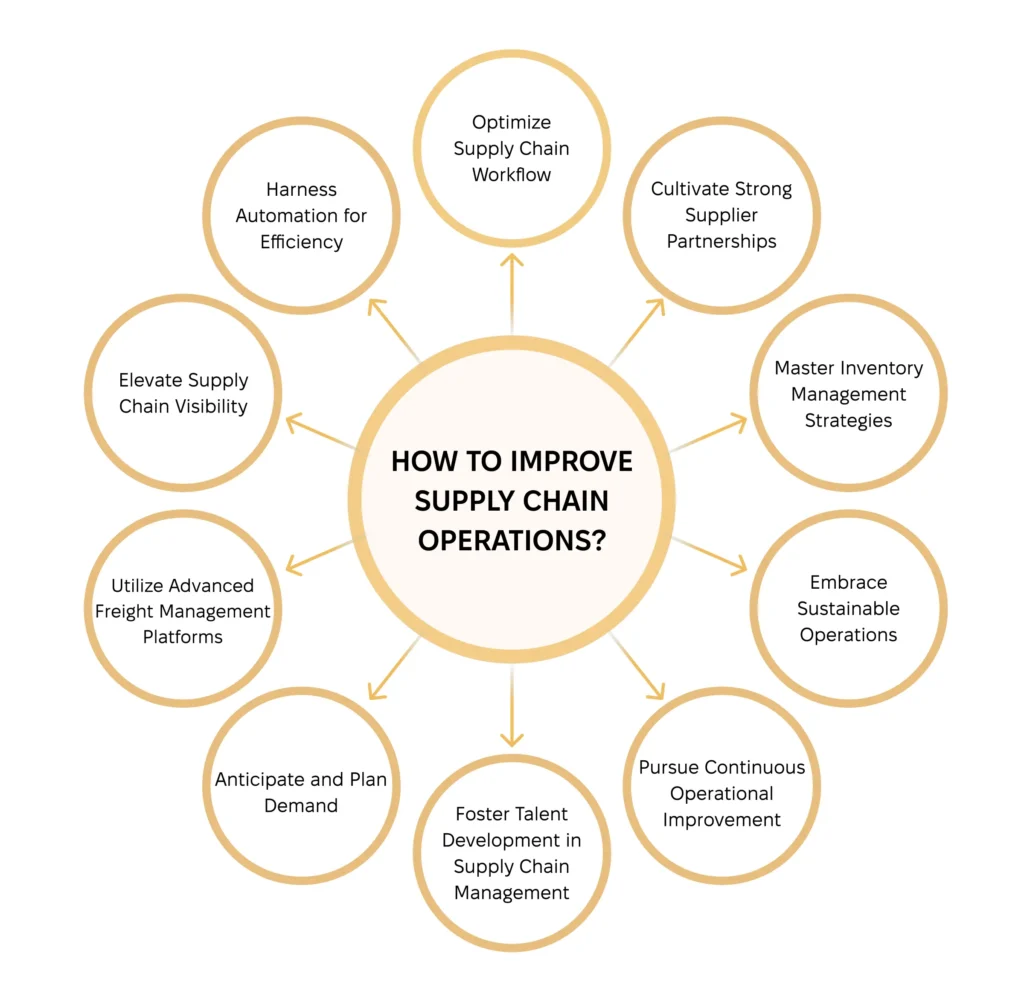
How to improve supply chain operations? Organizations can rely on best practices to enhance efficiency and streamline operations in pursuing supply chain excellence & resilience. In its 2026 report, WEF states that, over the previous five years, the number of business leaders who viewed resilience and agility as core competitive advantages increased by 60%.
This section explores ten strategies to improve supply chain, showcasing innovative approaches and technologies to optimize workflows and drive sustainable growth.
Optimizing supply chain processes involves conducting a comprehensive review of the entire workflow to identify inefficiencies and eliminate unnecessary steps. This includes refining inventory management practices, order processing procedures, and transportation routes. Begin by documenting how materials, products, information, and decisions move through the organization.
The map should cover:
Advanced analytics platforms and workflow automation tools facilitate supply chain process improvement by providing real-time insights into process bottlenecks. With these software solutions, organizations can develop optimization strategies to streamline operations, reduce cycle times, and enhance supply chain efficiency.
KPIs to track:
Read more about supply chain management software requirements in our blog.
Automation improves supply chain efficiency by eliminating manual tasks, reducing errors, and increasing operational speed. Companies can automate order processing, inventory management, and transportation scheduling using robotic process automation (RPA) and warehouse management system development (WMS).
Although only 23% of supply chain leaders reported having a formal supply chain AI strategy, AI maturity is becoming important in this industry. Companies are already exploring AI for demand forecasting, inventory optimization, supplier risk monitoring, document processing, and disruption detection.
However, successful adoption depends on more than implementing individual tools. Organizations need reliable data, integrated systems, clear governance, skilled employees, and measurable use cases to scale AI beyond isolated pilots and generate sustainable operational value.
KPIs to track:
Visibility provides insights into inventory levels, demand patterns, and logistical operations across the supply chain network. The need remains significant: only 42% of respondents in McKinsey’s 2025 survey had visibility into tier-two supplier risks or beyond, despite a 22-percentage-point annual increase in organizations reporting tier-two visibility.
A visibility platform may combine data from ERP, WMS, TMS, supplier, carrier, and customer systems into role-specific dashboards. Good visibility should help users take action, not just show more data. Dashboards need alerts, clear limits, assigned owners, and suggested next steps.
KPIs to track:
Digital freight forwarding platforms offer a convenient and efficient way to manage logistics operations. These online platforms leverage artificial intelligence (AI) and machine learning (ML) to optimize freight routing, match shipments with the most suitable carriers, and track deliveries in real time.
Digital freight forwarding platforms improve operational efficiency and reduce transportation costs. They enhance supply chain visibility by automating manual processes and streamlining communication between shippers, carriers, and customers. Additionally, these solutions often integrate seamlessly with existing systems, allowing for greater interoperability and data sharing across the supply chain ecosystem.
KPIs to track:
Demand planning should combine historical patterns with current operational and commercial signals, such as promotions, seasonality, open orders, pricing changes, economic indicators, and customer commitments.
Predictive analytics allows companies to develop more robust demand forecasts, align inventory levels with anticipated demand, and optimize production and procurement processes. It helps to reduce inventory holding costs, improve inventory turnover rates, and enhance supply chain agility.
AI and machine learning can help identify patterns, but adoption remains uneven. Currentlt, companies are planning, blueprinting, or piloting AI use cases, while only a small percentage is activaly deploying AI tools at scale.
KPIs to track:
Effective supplier relationship management ensures a reliable and resilient supply chain network. Supplier management platforms and vendor portals enable organizations to streamline communication, track supplier performance, and manage contracts more efficiently.
These solutions help organizations centralize supplier-related information and automate supplier onboarding and performance evaluations. They facilitate building stronger relationships with suppliers, mitigating risks, and driving continuous improvement across the supply chain.
KPIs to track:
Effective inventory management helps balanceen supply and demandminimize stockouts, and optimizeng working capital. Inventory optimization tools and RFID (Radio Frequency Identification) systems enable organizations to track inventory levels in real time, analyze demand patterns, and optimize replenishment strategies.
Implementing ways to improve supply chain management, such as advanced inventory tracking and automation, improves inventory accuracy, reduces excess inventory holding costs, and enhances supply chain resilience. Advanced inventory management systems can integrate with demand planning and warehouse management to provide end-to-end visibility and control over inventory-related processes.
KPIs to track:
Integrating sustainable activities into supply chain operations helps to reduce environmental impact, meet regulatory requirements, and enhance brand reputation. Sustainability management platforms and carbon footprint calculators enable organizations to track and analyze environmental performance metrics across their supply chain network.
With these platforms, organizations can identify opportunities for improvement, implement sustainable practices, and measure progress toward sustainability goals. Supply chain software solutions can provide insights into supplier sustainability practices, enabling organizations to make informed decisions about supplier selection and collaboration.
KPIs to track:
Continuous improvement is essential for maintaining competitiveness. Software like performance analytics dashboards enable organizations to monitor key performance indicators (KPIs), identify areas for improvement, and track progress toward strategic goals.
These solutions support supply chain improvement initiatives, helping companies foster a culture of continuous improvement, drive operational excellence, and stay ahead of market trends and customer expectations.
KPIs to track:
Building a skilled and capable workforce to drive operational excellence is vital for continuous supply chain improvements. Learning management systems (LMS) enable organizations to provide employees with access to professional development opportunities and training programs.
LMS solutions help to systematize training programs, enhancing employee skills, knowledge, and productivity. Collaboration features facilitate knowledge sharing and teamwork among supply chain professionals. It fosters innovation and continuous learning culture, improving supply chain performance and business outcomes.
KPIs to track:
Let Exoft assess your current systems and define a practical development roadmap.
No single KPI can represent overall supply chain performance. Organizations should use a balanced set of cost, service, speed, inventory, quality, and resilience metrics.
| KPI | What It Measures | Basic Calculation |
|---|---|---|
| Inventory turnover | How often inventory is sold or used | Cost of goods sold ÷ average inventory |
| Days inventory outstanding | Average number of days inventory remains in storage | Average inventory ÷ COGS × days |
| Forecast accuracy | Difference between forecast and actual demand | MAPE, WAPE, or another agreed method |
| OTIF | Orders delivered on time and in full | OTIF orders ÷ total orders × 100 |
| Perfect order rate | Orders completed without delays, damage, or documentation errors | Perfect orders ÷ total orders × 100 |
| Order cycle time | Time from order receipt to completion | Delivery time − order receipt time |
| Supplier defect rate | Share of received units that fail quality requirements | Defective units ÷ received units × 100 |
| Freight cost per order | Transportation spending relative to output | Total freight cost ÷ total orders |
| Stockout rate | Frequency at which products are unavailable | Stockout events ÷ demand events × 100 |
If you are looking for ways to improve your supply chain strategy, Exoft can help turn operational challenges into practical software solutions. We design and develop custom platforms that enable logistics, construction, and supply chain businesses to automate workflows, improve visibility, connect stakeholders, and manage complex operations more effectively.
One example is a custom construction supply chain management platform Exoft has been developing since 2020. The solution was created to replace fragmented tools and manual processes with a centralized platform for contractors, subcontractors, site managers, suppliers, and logistics teams.
Today, more than 200 construction professionals actively use the platform. By the last quarter of 2023, it had already supported over 20,000 deliveries and more than 3,500 resource bookings.
Partnering with Exoft ensures lower costs, improved efficiency, scalability, market competitiveness, enhanced customer satisfaction, and better risk management. Our custom software solutions help businesses improve management of the supply chain and thrive.
Modern supply chain management requires proactive strategies and innovative solutions. Businesses can enhance their efficiency and resilience by effectively addressing disruption and rising costs. The supply chain improvement examples, such as workflow optimization, automation, and visibility, will help achieve sustainable growth and maintain competitiveness.
Exoft empowers supply chain mastery through innovative custom solutions. Our innovative software empowers businesses to streamline operations and cut costs effectively. Partnering with us ensures efficiency, scalability, and enhanced competitiveness.
Contact us to for an in-depth consultation on enhancing your supply chain strategy.
You can make your supply chain efficient and responsive through careful planning, streamlined processes, and agile adaptation to changing demands.
Enhancing supply chain management efficiency entails optimizing processes, leveraging technology, fostering stakeholder collaboration, and implementing relevant metrics. Supply chain inventory turns, on-time delivery rates, and order fulfillment cycle times are among the KPIs that drive supply chain improvement.
Efficient supply chain improvements can be sustainable by integrating eco-friendly practices, ethical sourcing, and waste reduction initiatives.
To improve quality in the supply chain, you can implement rigorous quality control measures, foster supplier partnerships, and leverage technology for real-time monitoring and tracking.
Hospitals, retailers, manufacturers, distributors, and consumers benefit from improved supply chain efficiency through better product availability, reduced costs, and enhanced service levels.